
What Caroline County Deeds Convey
The Circuit Court Clerk records deeds and every other instrument affecting Caroline County land. The instrument label helps narrow the index. But the document text controls what was actually conveyed. Maryland property records may use several deed forms. A parcel search should never assume that every deed reflects an ordinary arm's-length sale.
| Deed type | What it does | Typical record question |
|---|---|---|
| General warranty deed | Conveys the stated interest with broad title covenants | Was land sold with warranty protections? |
| Special warranty deed | Limits covenants to claims arising through the grantor | What promises accompanied this transfer? |
| Quitclaim deed | Conveys whatever interest the grantor may hold | Was a possible interest released or rearranged? |
| Trustee or personal-representative deed | Transfers land through an authorized fiduciary | Did an estate, trust, or court process drive the sale? |
| Tax-sale deed | Records a transfer following the applicable tax-sale process | Was delinquent-tax litigation part of the title trail? |
The differences matter. A deed conveys an interest, while a deed of trust secures debt. A release can discharge that debt. An easement grants a defined use of the land. All four may sit side by side in the same land-record index. Each does entirely different legal work.
Search Caroline County Deeds in MDLandRec
MDLandRec serves as Maryland's digital gateway to land records. A free account unlocks it. Index data flows in nightly from Judicial Information Systems, and the Maryland State Archives preserves the historic indexes and images behind the newer material.
| Search field | Choices or format | How to use it |
|---|---|---|
| Party name | Corporate, or first/middle/last/suffix | Use the exact deed name, then test variants |
| Ownership and party type | Corporate or Individual; Grantor or Grantee | Separate conveying parties from recipients |
| Instrument and capacity | Document type and legal role | Narrow deeds, releases, easements, trustees, or representatives |
| Reference | Book/page or cross-reference book/page | Open a known citation directly |
| Date range | Beginning and ending dates | Contain common-name results |
Spelling shifts, maiden names, missing initials, and old indexing habits can all hide a name. MDLandRec answers with contains, begins-with, ends-with, fuzzy, and soundex operators. Search a company exactly as the grantee line spells it. For individuals, drop the middle initial or suffix only after saving the first result set. The MDLandRec login screen offers account creation. It also shows Email and Password fields, an access-code route, and help contacts.
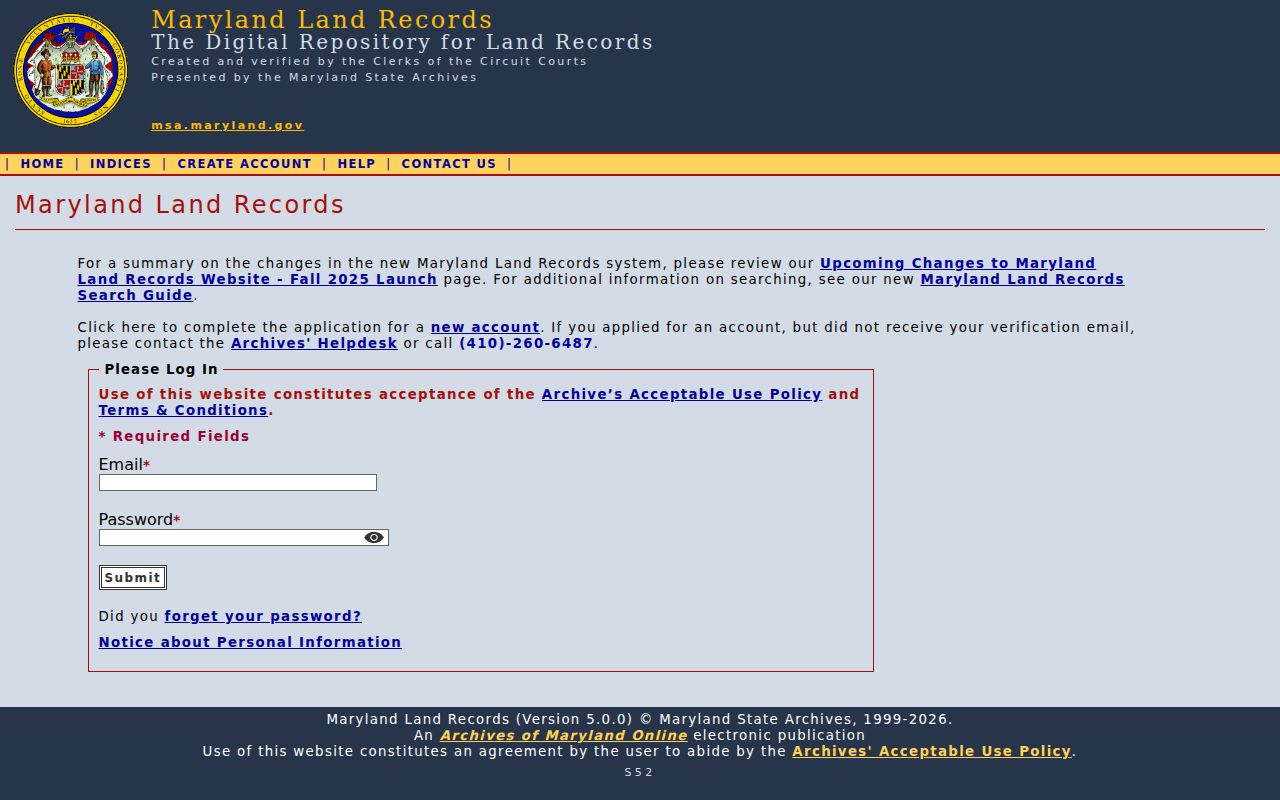
Logging in is just an access step. It does not confirm that a particular Caroline County deed is inside until you actually search.
Follow Caroline County's Grantor-Grantee Chain
A grantor conveys the interest, and a grantee receives it. That two-party structure lets a researcher walk backward from a current transfer to earlier ones without rebuilding an entire property search from scratch.
- Take the current Liber/Folio from the SDAT property result or a known deed.
- Open that deed and record the grantee, grantor, execution and recording dates, legal description, and prior references.
- Search the grantor as a grantee in an earlier date range. Match the land description, not just the surname.
- Repeat through each prior transfer. Move to historic books, indexes, or microfilm when the electronic run stops.
- Chain of title
- The ordered series of instruments through which an interest passed.
- Liber/Folio
- The land-record book and page citation.
- Instrument number
- A separate unique recording identifier used in applicable data groups.
- Cross-reference
- A pointer from one recorded item to a related book and page.
Names alone prove little. A spouse, trustee, estate, or company may appear under a legal capacity that looks nothing like the familiar name. Before adding any deed to the chain, match the tract, lot, plat, adjoining owners, and the prior citation.
Caroline County's Three Digital Milestones
Caroline's MDLandRec data groups carry the labels COTT 1968, CAIS 1994, and ELROI 2004. Those years mark electronic index environments, not the start of land ownership in Caroline County. Nor do they promise that every older image lives inside the same interface. A search that crosses one of these milestones may find different field labels. Image availability can change too. Entering a reference may take a new form. Write down the book and page plus the collection name at every handoff. What stays stable is the recorded citation and the land description. The look of a portal screen never matters.
Note: Treat 1968, 1994, and 2004 as system milestones, not as the first years of Caroline County deed records.
Caroline County Deed Books Reach 1774
The Maryland State Archives Caroline guide lists CM247 court land records covering 1774 through 1851. It also lists CM248 grantee indexes and CM249 grantor indexes for the same span. Later land-record, microfilm, plat, tax-sale, and estate collections extend the trail from there.
That depth reaching back to 1774 is one of Caroline County's strongest research assets. A finding-aid entry may point to an offsite box. It may instead point to a microfilm reel rather than an online image. Record the CM collection number, volume, date span, and custodian. Those four details give archive or courthouse staff an actionable request. The MSA guide screen shows how the historic holdings are arranged. The land, plat, tax, and probate series each get their own layout.
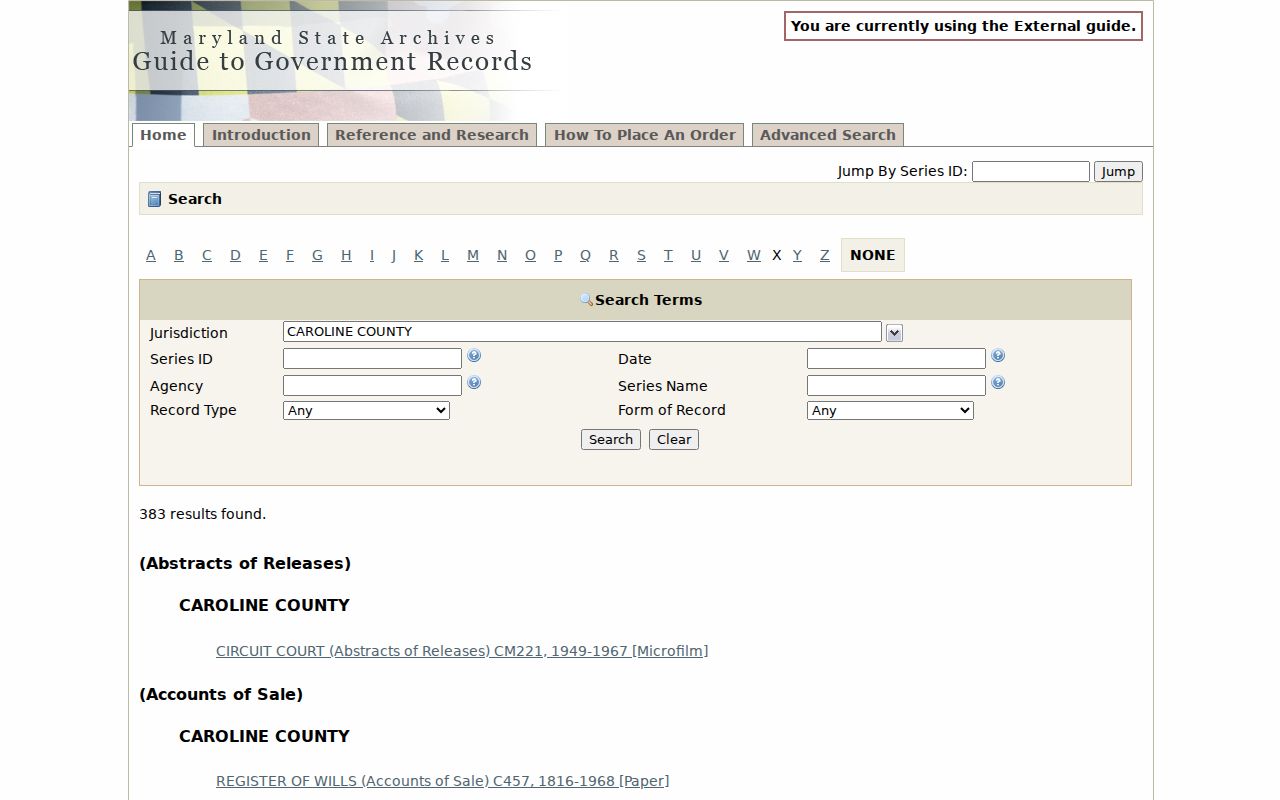
When a historic deed image is missing from the modern portal, the collection listing supplies the continuity key.
Plats Complete Caroline County Deed Descriptions
A Caroline County deed may describe land in several ways. It can use a subdivision, lot and block, metes and bounds, or a referenced plat. For plat images, Plats.net is the parallel Maryland route with county selection. Caroline's archival holdings add historic plat indexes. These include equity and court plats, land-record plats, tax-sale plats, and modern subdivision series. Town approval and county recording remain two separate steps. Planning records in Denton, Federalsburg, and Greensboro can supply a project or applicant name. The stamped, recorded plat still controls the legal lot configuration. Search the deed's exact plat reference instead of trusting a marketing name.
Read Liens Beside Caroline County Deeds
Mortgages, deeds of trust, releases, assignments, easements, powers of attorney, and certain liens all live in the same recorded trail as deeds. The Circuit Judgment/Lien search finds a person or company by county and filing dates. Treat its result as a lead, never as the full status of title. Check each judgment in the court docket. Then trace any land-record effect and the later satisfaction or release. A released deed of trust should tie back to its original reference. An assignment can move a secured interest without conveying the land itself.
Caroline County Tax-Sale Deed Trail
The county's 2026 tax-sale page advertises an online auction set for August 20 and 21. It links to registration, eligible properties, results, surplus funds, and the State Tax Sale Ombudsman. Vendors and dates shift from year to year. Note the page date along with the account number.
A tax-sale listing is not a deed. The account must be followed through redemption, any court case, and the final recorded instrument. Surplus-funds records can point to a former owner or lienholder. Every name still needs confirmation against the case file and the land records.
Obtain a Caroline County Deed
The Caroline County Circuit Court Clerk sits at 109 Market Street, Denton. Land Records answers at 410-479-1142; the main clerk number is 410-479-1811. Copies run four ways: online images, courthouse terminals, an in-person counter request, and mail. Plain copies are listed at $0.50 per page. Confirm certification fees and current charges before ordering.
Give the clerk a party name and record type. Add an approximate year. A book/page or instrument number helps too. The Maryland land-records access guide explains online accounts and courthouse terminals. It also covers copies and the limit on clerk-performed research. If older deed records sit at MSA, include its collection number.
The county's recordation page shows deed drop-off and processing instructions and the local recordation-tax route.
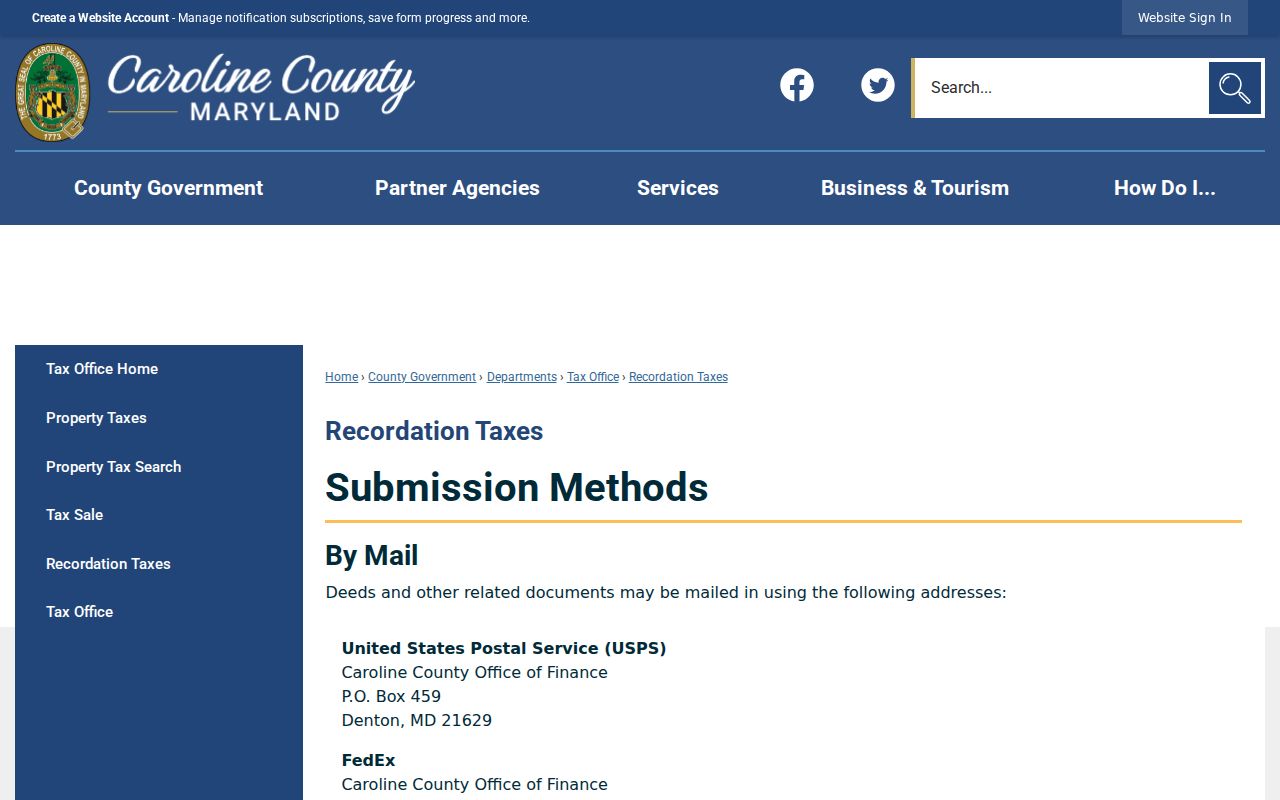
Note: The published delivery instructions separate recording a brand-new deed from requesting a copy of one already on file.
Recorded does not mean guaranteed. The Caroline County deed index reports filed instruments. It is not a title opinion, and unrecorded interests may exist.
Bridge Gaps in Caroline County Deeds
Not every Caroline County deed follows a clean seller-to-buyer line. An estate sale or court-ordered transfer breaks the pattern. Caroline probate holdings cover a lot of ground. Accounts of sale run from 1816 through 1968, real-estate accounts from 1866 through 1971, and original sales from 1785 through 1935. Petitions and orders run from 1792 through 1972. The Register of Wills and Orphans' Court sits at 109 Market Street, Room 119. It can route a request by estate number, decedent name, or date. These files often reveal a personal representative, the heirs, the authority for a sale, or a fiduciary deed. Old newspapers fill in missing search terms. The Caroline County Public Library offers Denton Journal searching for 1870 through 1965. It also provides genealogy databases and local-history collections. MSA's catalog reaches even further back. It covers the Denton Journal from 1847 through 1965. It also lists the Federalsburg Courier, the Federalsburg Times, and Greensboro's Enterprise. An executor's notice, an auction ad, a tax sale, a hearing, or an old road name can pin down the year and party. The deed index needs exactly that. A newspaper item is supporting evidence, never the conveyance itself. Write down the title, issue date, page, names, and property description. Then confirm the actual transfer in the Caroline County deed records. The same caution applies to farm names and subdivision nicknames. Use them to locate a plat or a party. Then return to the recorded instrument and its exact land description. When remote searching stalls, ask the library reference desk for the exact publication and issue. Ask MSA for the cited collection and container. Or bring the deed reference to the courthouse terminal. These channels keep the trail intact without pretending every historic Caroline deed has been digitized. Dates matter.