
Find Out Who Owns a Caroline County Property
The workable order runs from the land itself to the assessment account. It then moves to the recorded conveyance. No single Caroline County portal proves every part. Maryland's assessment roll supplies the owner display and the parcel key for a property search. Deed records kept by the Circuit Court Clerk then name the grantee who took title.
- Locate the premises address in SDAT Real Property Search.
- Copy the owner name, mailing address, map, parcel, account, and Liber/Folio.
- Open MDLandRec and find the newest recorded conveyance.
- Match its grantee and legal description to the SDAT parcel.
- If an entity owns it, check that entity in Maryland Business Express.
This route answers who owns a property in Caroline County without assuming the person at the address holds title. SDAT cannot search by owner name, town, or ZIP. Start with the address, account, map/parcel, or sales mode instead.
Compare Caroline County Property Owner Sources
Each Caroline County source answers a narrower ownership question.
| Where ownership appears | What it gives | Currency |
|---|---|---|
| SDAT roll | First-line owner, mailing and premises addresses, parcel and deed references | Updated daily, subject to transfer processing |
| MDLandRec | Grantor, grantee, instrument, date, legal description | Newest recorded deed is stronger conveyance evidence |
| Caroline County GIS | Parcel geometry, label, and property-table clues | Context, not title proof |
| Business Express | Entity status, agent, office, and filings | Entity record, not beneficial ownership |
A mailing address only tells you where notices go, not where the land sits or who lives there.
Read Caroline County's SDAT Owner Display
SDAT pulls Owner Name from the last recorded deed. A result may show only the first owner line. Copy ET AL, ET UX, T/E, WF, fiduciary terms, punctuation, and suffixes exactly as displayed. Homestead and principal-residence fields are assessment clues, not proof of occupancy or complete title. The official SDAT entry page starts the address-to-owner route.
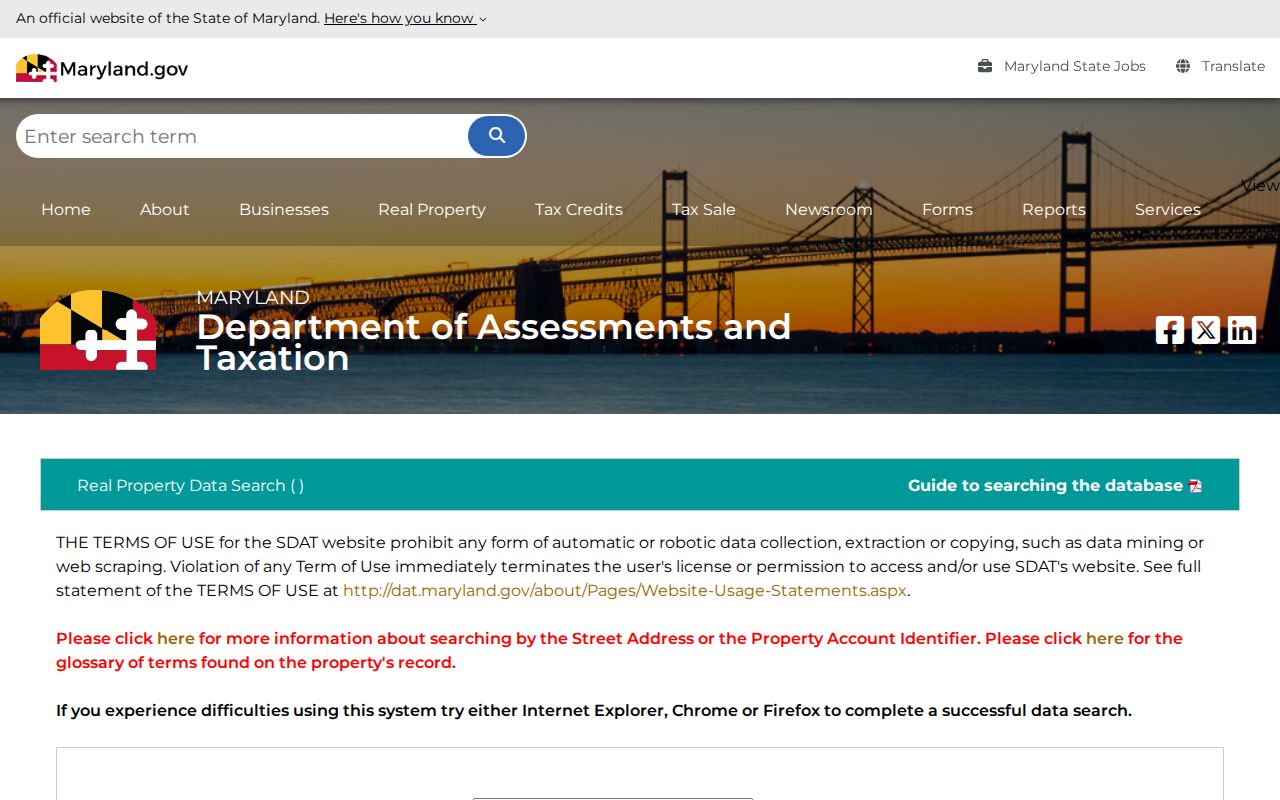
The SDAT search screen is a gateway, not an owner result. Select Caroline County, then enter the premises address or parcel key to pull up the record.
- Owner of record
- The holder shown in a public assessment or land record.
- Grantee
- The party receiving an interest in a deed.
- Situs
- The physical premises address.
- Mailing address
- The destination for notices, which may be elsewhere.
Trace a Caroline County Owner Name to the Deed
MDLandRec requires a free account. Prefer searching by Liber and Folio. That deed reference cuts through name ambiguity; otherwise run the displayed holder as grantee within a date range tied to the sale field. The search aid supports contains, begins with, ends with, fuzzy, and soundex matching, and the MDLandRec login offers account creation plus Help and Contact routes.
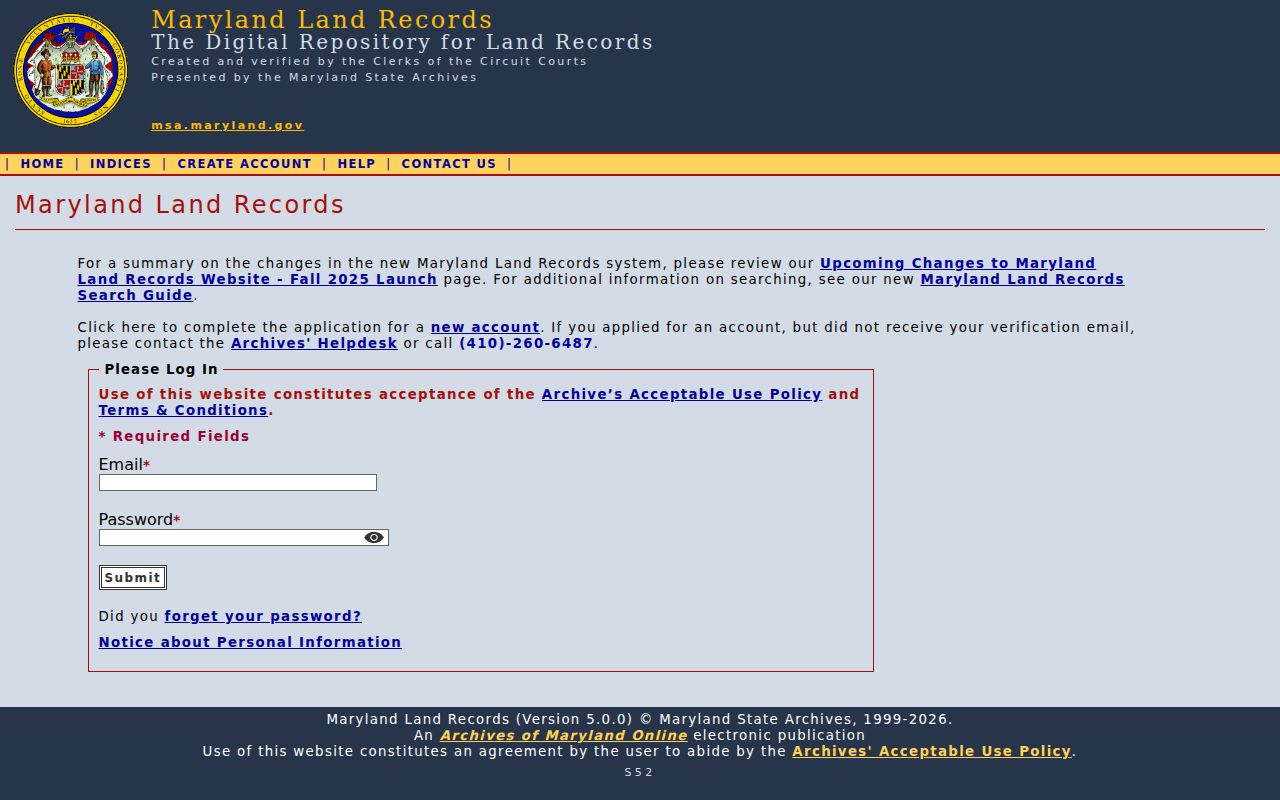
Match the grantee name and the property description against the parcel you are chasing. Caroline County groups labeled 1968, 1994, and 2004 are just electronic milestones. They do not limit how far back a deed search can go.
If the portal lets you down, head to a courthouse terminal or call Land Records at 109 Market Street, Denton, 410-479-1142. Have the party name, the year, a deed reference, and a parcel clue ready.
Identify an LLC, Trust, or Estate Owner
Search the exact entity in Maryland Business Express. An LLC name answers who owns the recorded parcel. It is more direct than any person connected with the company. Filings show status, resident agent, and principal office, not a property address. None of that makes the agent the beneficial owner.
Preserve trust and estate wording exactly. Then search MDLandRec with roles such as trustee, personal representative, estate, agent, or assignee. Probate transfers can also lead to the Caroline County Register of Wills and Orphans' Court.
Note: Entity records explain capacity; the recorded instrument shows what interest reached the grantee.
Separate Caroline County Mailing and Premises Addresses
Someone asking who owns this property may begin with a mailbox label or a town-style address. The premises field identifies the land itself. The mailing field is only a contact clue. GIS also separates town boundaries from ZIP boundaries, so a 21629, 21632, or 21639 address may lie outside Denton, Federalsburg, or Greensboro. When the mailing address names a company, trust, or former owner, compare it against the deed date, entity record, probate material, and tax account. Never assume the addressee occupies the parcel.
Resolve a Recent Caroline County Owner Change
A recorded deed can be newer than the assessment display. Closing and recording are separate events. Keep a full trail. Log the SDAT retrieval date, sale date, Liber and Folio, and deed recording date, and when names differ, ask the correct custodian rather than silently declaring one source wrong. SDAT says its data is updated daily. Daily updates do not promise same-day reflection of a closing; corrections belong with SDAT, while deed-image or index questions belong with the Circuit Court Clerk.
Respect Safe at Home in Caroline County Research
Maryland Safe at Home gives eligible protected people a substitute address and mail forwarding. Its real-property guidance says contact the program first. It warns that a deed cannot be redacted once public, and it applies before buying or financing land. Never try to defeat a substitute address. Public access does not authorize harassment. Nor does it permit repeated unwanted contact, threats, or surveillance; correction, court restriction, voter confidentiality, and commercial privacy processes each address a different record layer.
Know What an Ownership Lookup Cannot Prove
The tax roll can identify an owner of record. A deed can name a grantee. Neither alone guarantees complete title, because estates, trusts, entities, liens, easements, litigation, unrecorded interests, and later instruments may all affect the answer.
Owner name is not a title search. Use Caroline County records for lawful property research, never to target, stalk, intimidate, or harass anyone.
The current-owner guide and former-owner trail split ownership research.
Cross-Check a Caroline County Owner with the Correct Town
A question about a building, a subdivision, or a zoning action often leads to a municipal file rather than title records. Check the parcel against Caroline GIS Town Boundaries first. Denton, Federalsburg, and Greensboro each hold local planning material. Property assessment and recorded ownership remain county and state functions, so the owner of record does not change with the town hall. A town-style postal address alone never selects the custodian.
Denton posts applications, notices, and subdivision rules online. Federalsburg publishes Planning Commission agendas and minutes. Greensboro offers permit categories, land-subdivision and floodplain applications, a zoning map, and planning minutes. No town here offers an address-keyed permit search. Ask the town directly. Give staff the street address, map and parcel number, owner or developer, approximate years, and the specific permit, inspection, certificate, subdivision, or code record you need.
A town file explains authorization or planning history. The current owner of record still comes from SDAT and the recorded deed. A permit applicant, contractor, developer, or meeting speaker is not automatically the grantee. Follow any project name or planning identifier back to the approved plat and land record before treating it as proof of ownership.
Search Caroline County Owner Names Without Losing Variants
Names rarely appear in one fixed form across Caroline County records. A missing middle name causes trouble. So can a maiden name, a suffix, a new spelling, an abbreviation, or a fiduciary role, any of which can hide the correct deed from an exact query. Start with the spelling shown on the SDAT result. Then try the official MDLandRec operators: contains, begins with, ends with, fuzzy, and soundex. Switch between corporate and individual ownership types only when the record itself supports that choice.
| Name clue | Useful adjustment | What to verify |
|---|---|---|
| ET AL or second grantee missing | Open the complete deed image | Every grantee and legal capacity |
| Historic spelling variation | Fuzzy or soundex search | Book/page and matching land description |
| Trustee or estate wording | Use legal-capacity and role terms | Authority and instrument type |
| LLC or corporate holder | Corporate-name search, then Business Express | Exact entity and parcel, not merely agent address |
When a deed name still will not surface, pull the prior Liber/Folio cited by the newest instrument instead of drifting into a broad person search. The parcel anchors everything. So do the legal description and recorded references. Those recorded controls are what keep similar names apart. Caroline's small-town scale makes exact dates and places useful.
Property acquired through a tax sale, foreclosure, estate, or trustee transaction often shows an intermediate legal role as the most visible name. Read the instrument type and capacity first. Decide who owns the parcel only after that. Caroline's tax-sale page, court case system, judgment search, and probate records can explain the route. The final comparison still returns to the parcel and the newest recorded deed. A tax-sale list is not a deed. Neither is a court caption. For a case file, give the clerk the case number, caption, filing year, and document type; for probate, the estate number or the decedent and death date. Those focused keys keep a same-name result from attaching to the wrong Caroline County property owner.